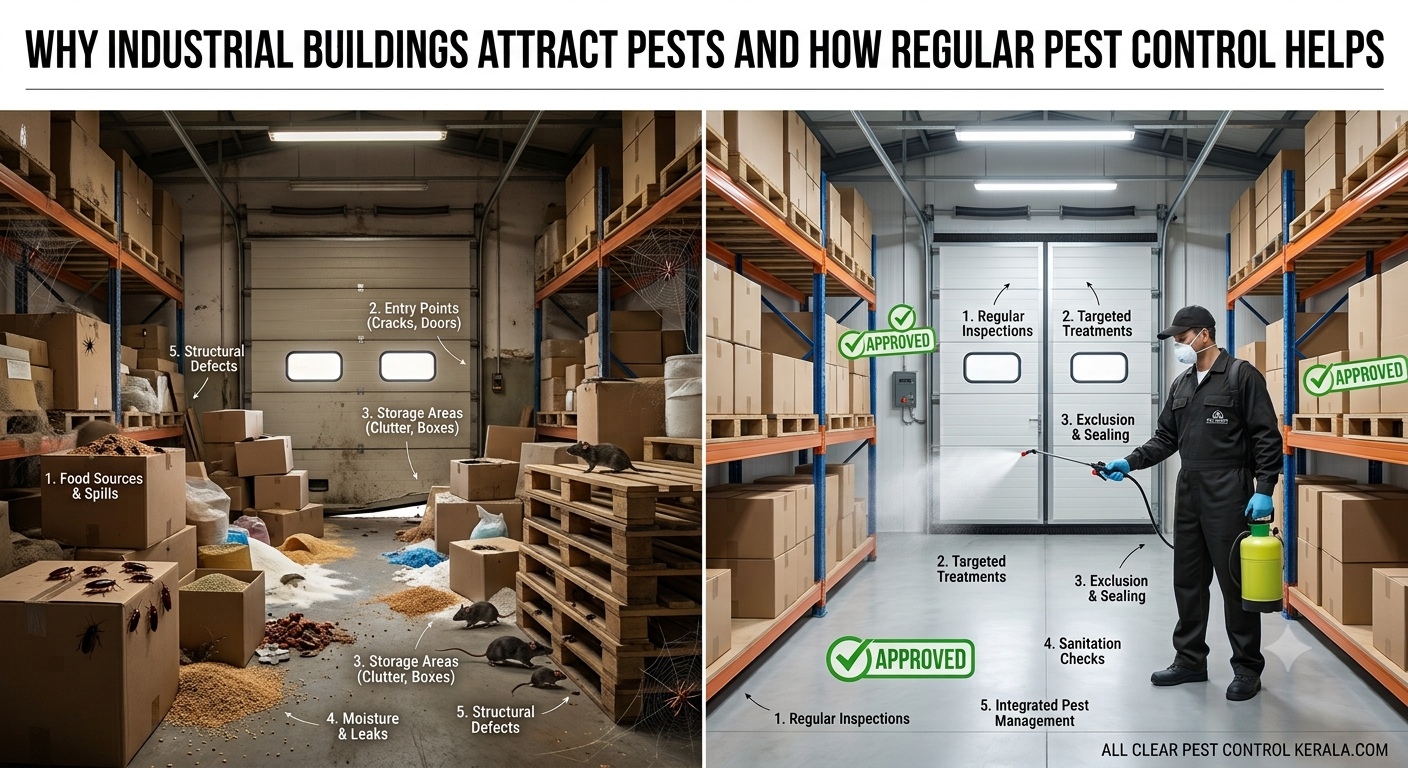
Why Industrial Buildings Attract Pests and How Regular Pest Control Helps
Industrial buildings and warehouses are magnets for pests, often without owners realizing it until stock is damaged, machinery is compromised, or an inspection turns up an infestation. Unlike a home, an industrial facility has large storage areas, constant deliveries, and hard-to-reach corners — all conditions pests thrive in. Understanding why this happens is the first step toward preventing costly damage and health risks.
Why Industrial Spaces Are So Pest-Prone
1. Large, undisturbed storage areas
Warehouses stack goods high and store them for long periods. Pallets, cardboard, and packaging create dark, quiet spaces where pests can nest undisturbed for weeks.
2. Constant movement of goods
Every incoming shipment is a potential pest carrier. Cockroaches, ants, and rodents frequently travel in with raw materials, packaging, or delivery vehicles, making warehouse pest control an ongoing need rather than a one-time fix.
3. Food and organic waste
Facilities with pantries, break rooms, or food-processing units generate crumbs and waste that attract cockroaches and ants almost immediately. Even a small canteen inside a large industrial unit can trigger a facility-wide infestation if not managed.
4. Moisture and poor drainage
Industrial buildings often have complex plumbing, cooling systems, and drainage networks. Leaks and condensation create the damp environment pests need to survive and breed.
5. Structural gaps
Loading docks, ventilation shafts, and expansion joints are common entry points. These gaps are easy to overlook during routine facility checks but are exactly where pests get in.
Common Pests Found in Industrial and Office Buildings
- Cockroaches – Thrive near canteens, break rooms, and drainage systems. A serious cockroach pest control plan is usually non-negotiable in any facility handling food or packaging.
- Ants – Enter through the smallest cracks and are drawn to sugar, grease, and food waste in staff areas.
- Rodents – Chew through wiring and packaging, posing both safety and stock-damage risks.
- Stored-product pests – Beetles and moths that specifically target grains, textiles, or packaged goods in storage.
These aren't just warehouse problems — the same pests show up in office pest control cases, particularly around pantries and shared kitchens, and eventually spread into surrounding residential pest control needs if the buildings are near homes.
The Real Cost of Ignoring Pest Problems
For an industrial or commercial property, a pest infestation isn't just an inconvenience — it can mean:
- Damaged inventory from rodents, beetles, or moisture-loving insects
- Health and safety violations, especially for food-handling or export-certified facilities
- Equipment and wiring damage caused by gnawing pests
- Reputational risk, since one bad inspection or client visit can affect contracts and audits
- Employee wellbeing issues, as cockroach and rodent activity in break rooms or restrooms lowers morale
This is why industrial pest control needs to be scheduled and proactive, not reactive.
How Regular Industrial Pest Control Helps
1. Scheduled inspections catch problems early
Routine checks of loading docks, storage racks, drainage lines, and break rooms help identify pest activity before it spreads across the facility.
2. Targeted treatment for high-risk zones
Professionals treat specific problem areas — such as kitchen cockroach treatment in canteens, or ant treatment near sugar and grease-prone zones — rather than applying a blanket approach that wastes time and product.
3. Safe, compliant methods for industrial use
Facilities handling food, pharmaceuticals, or exports need treatments that meet safety standards without affecting products or staff. A professional pest control service understands which methods are compliant for each setting.
4. Ongoing prevention, not just removal
Sealing entry points, managing moisture, and setting up monitoring stations prevent pests from returning after the initial treatment — which is far more cost-effective than repeated emergency call-outs.
5. Documentation for audits
Regular pest control visits generate reports that are often required for compliance audits, especially in export-oriented or food-grade industrial units.
It's Not Just Warehouses — Offices and Homes Need the Same Attention
While this article focuses on industrial buildings, the same pest triggers — food waste, moisture, and structural gaps — apply to smaller spaces too:
- Office pest control keeps pantries, restrooms, and storage rooms free of cockroaches and ants that can affect employee health and client impressions.
- Home pest control and residential pest control address the same issues at a smaller scale: kitchen cockroach treatment for infestations around stoves and sinks, and home ant treatment for the trails that often lead straight to a sugar bowl or pet food bowl.
Whether it's a 50,000-square-foot warehouse or a two-bedroom kitchen, the principle is the same: pests go where there's food, moisture, and shelter, and regular treatment is what keeps them out for good.
Choosing the Right Pest Control Partner
For industrial and warehouse pest control, look for a provider that offers:
- Facility-specific risk assessments
- Treatments compliant with food-safety and export standards
- Scheduled maintenance visits, not just one-off treatments
- Experience across industrial, office, and residential pest control, since many facilities need all three
All Clear Pest Control (Kerala) works across industrial, commercial, and residential properties, offering tailored plans for warehouses, offices, and homes — from cockroach and ant treatments to full-scale industrial pest management.
FAQs
How often should an industrial building get pest control treatment?
Most facilities benefit from quarterly treatments, though high-risk areas like food storage or canteens may need monthly checks.
Can pest control be done without disrupting warehouse operations?
Yes. Professional providers schedule treatments around working hours and use methods safe for staff and stored goods.
Do offices need the same pest control as warehouses?
Offices face smaller-scale versions of the same risks — mainly around pantries and restrooms — and benefit from the same proactive approach.